What's New in DBOS - August 2026

It's been another busy summer month at DBOS–big improvements in queueing performance, DBOS Go 1.0 is released, and a new CLI for DBOS Conductor! Here’s a summary of all things new:

New in DBOS Transact open source libraries

  • 10x better partitioned queue performance
  • More flexible database migration tooling
  • Better interoperability across applications and languages
  • DBOS Golang v1.0 release

New in DBOS Conductor

  • A public Conductor HTTP API specification
  • The new dbosctl command-line interface
  • Metrics preview page

Read on for the details.

New Features in DBOS Transact

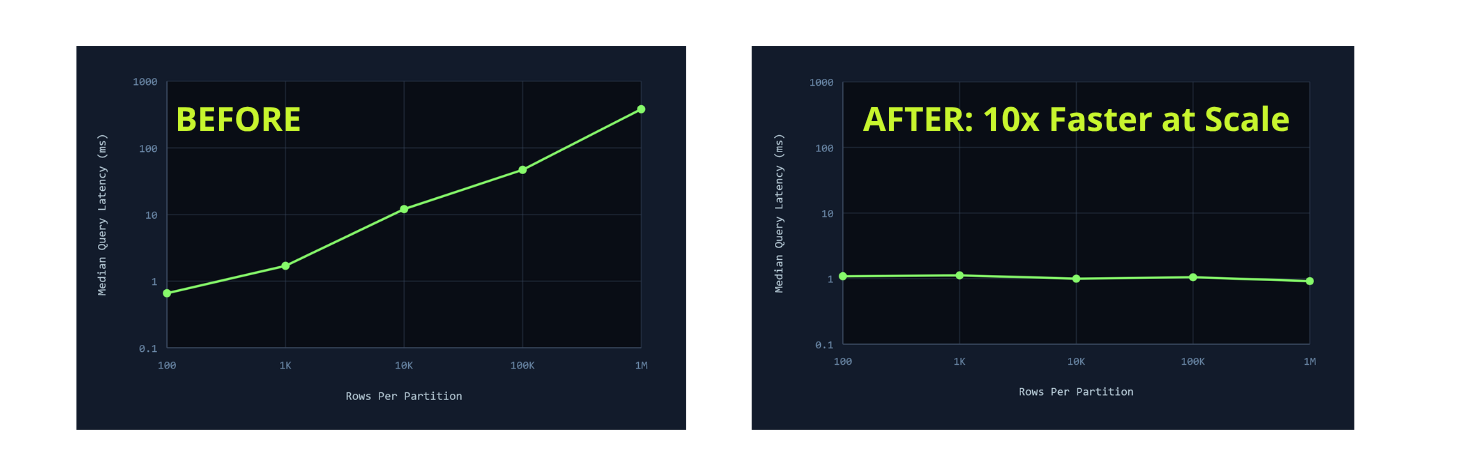
10x Faster Partitioned Queue Performance

We significantly improved the performance of partitioned queues, delivering an order of magnitude higher throughput while maintaining low latency, even when queues contain large numbers of tasks. The optimizations include:

  • More efficient indexes, reducing the database resources required for each queue poll.
  • Batched dequeues, allowing a worker to dequeue tasks from multiple partitions in a single transaction.
  • A faster alternative to SELECT DISTINCT, which we discovered was a major bottleneck at scale. Read our technical deep dive to learn how we diagnosed and worked around the query-planning issue.
Partitioned queues are especially useful when your application runs tasks for many users or tenants. Unlike a regular task queue, a partitioned queue applies concurrency limits independently to each partition. This prevents a single tenant from consuming all available resources while still allowing tasks from many tenants to run concurrently.

In practice, we see people using partitioned queues to achieve fairer resource allocation, more predictable latency, and significantly higher throughput for multi-tenant workloads.

More Flexible Migration CLI Tooling

You can now print DBOS database migrations as a batch of raw SQL commands instead of executing them immediately. You can print either every migration for a fresh database or only the migrations after a specified version when upgrading an existing database.

The new options are:

  • --print-migrations <all|NUMBER>: Prints migration SQL to standard output instead of running it. Use all for a fresh PostgreSQL database or provide a migration number when upgrading an existing database.
  • --print-user-role: Prints the SQL statements that grant the application role access to DBOS system tables instead of executing them.

This gives you more control over how and when schema changes are applied. For example, a database administrator can review and execute migrations using a privileged role, while the application itself runs with a more restricted role. You can also incorporate the generated SQL into your existing deployment, review, and approval processes.

Available today in TypeScript, Python, and Go. Java support is coming soon.

Better Interoperability Across Applications and Languages

Multiple DBOS applications, including applications written in different programming languages, can now share a single DBOS system database.

Each application is identified by its configured name and owns the resources it creates, including workflows, steps, queues, schedules, and application versions. Applications are isolated from one another by default, but can interoperate explicitly by referring to each other by name.

For example, one application can enqueue a workflow owned by another application and wait for its result:
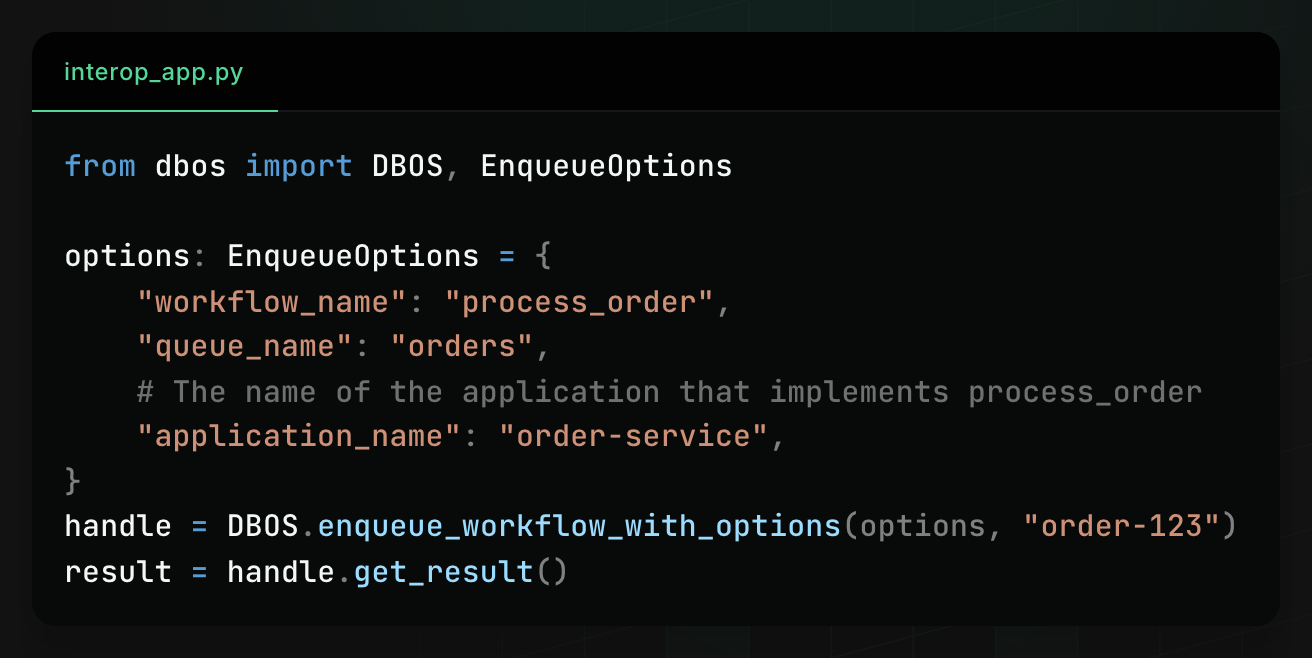
This is particularly useful for systems composed of multiple microservices or languages. Instead of operating a separate DBOS system database for every service, applications can coordinate through one shared database without interfering with one another.

This makes polyglot architectures simpler to deploy and operate while enabling durable, cross-application workflows. Read the documentation for usage details.

DBOS Golang v1.0 Release

DBOS Go 1.0 marks the DBOS Transact Golang as production-ready, with feature parity across the core DBOS programming model and a stable public API.

The new features include:

  • Database-backed queues and schedules. Queues and schedules can now be created at any time, including after application startup or through a DBOS client. They are visible to every process sharing the system database, replacing the previous in-memory interfaces. This makes them easier to manage in distributed and dynamically configured deployments.
  • A simpler client API. Client is now a sub-interface of Context, eliminating the duplicated Client* generics. One set of package-level functions now works both inside a DBOS application and from an external process, reducing API surface area and simplifying reusable code.
  • SQLite is now optional. Postgres-only applications no longer compile or link modernc.org/sqlite, reducing unnecessary dependencies and binary overhead.

DBOS Go 1.0 includes breaking changes. Read the upgrade guide for migration recommendations.

Going forward, we expect the public API to remain backward-compatible across minor releases, 

making upgrades more predictable and reducing ongoing maintenance.

New Features in DBOS Conductor

Public Conductor HTTP API Specification

DBOS Conductor now provides a public HTTP API specification, enabling you to integrate Conductor directly into your own tools and automation.

Through the API, you can:

  • Register applications and configure their settings
  • Search, inspect, cancel, and fork workflows
  • Inspect queues and schedules
  • Trigger and manage schedules
  • Read metrics and audit logs
  • Manage members, roles, and API keys

The API is described by an OpenAPI 3.1 specification generated directly from the running server, ensuring that the specification matches the deployed version of Conductor.

You can use the API with both DBOS-managed and self-hosted Conductor deployments. The specification also makes it easy to generate typed clients, build internal operational tools, or integrate Conductor with existing platforms.

Read the documentation for deployment and usage details.

The New dbosctl Command-Line Interface

We released dbosctl, a command-line client for the Conductor HTTP API. It lets you manage workflows, queues, schedules, applications, and API keys from your terminal.

It works with both DBOS-managed and self-hosted Conductor deployments.
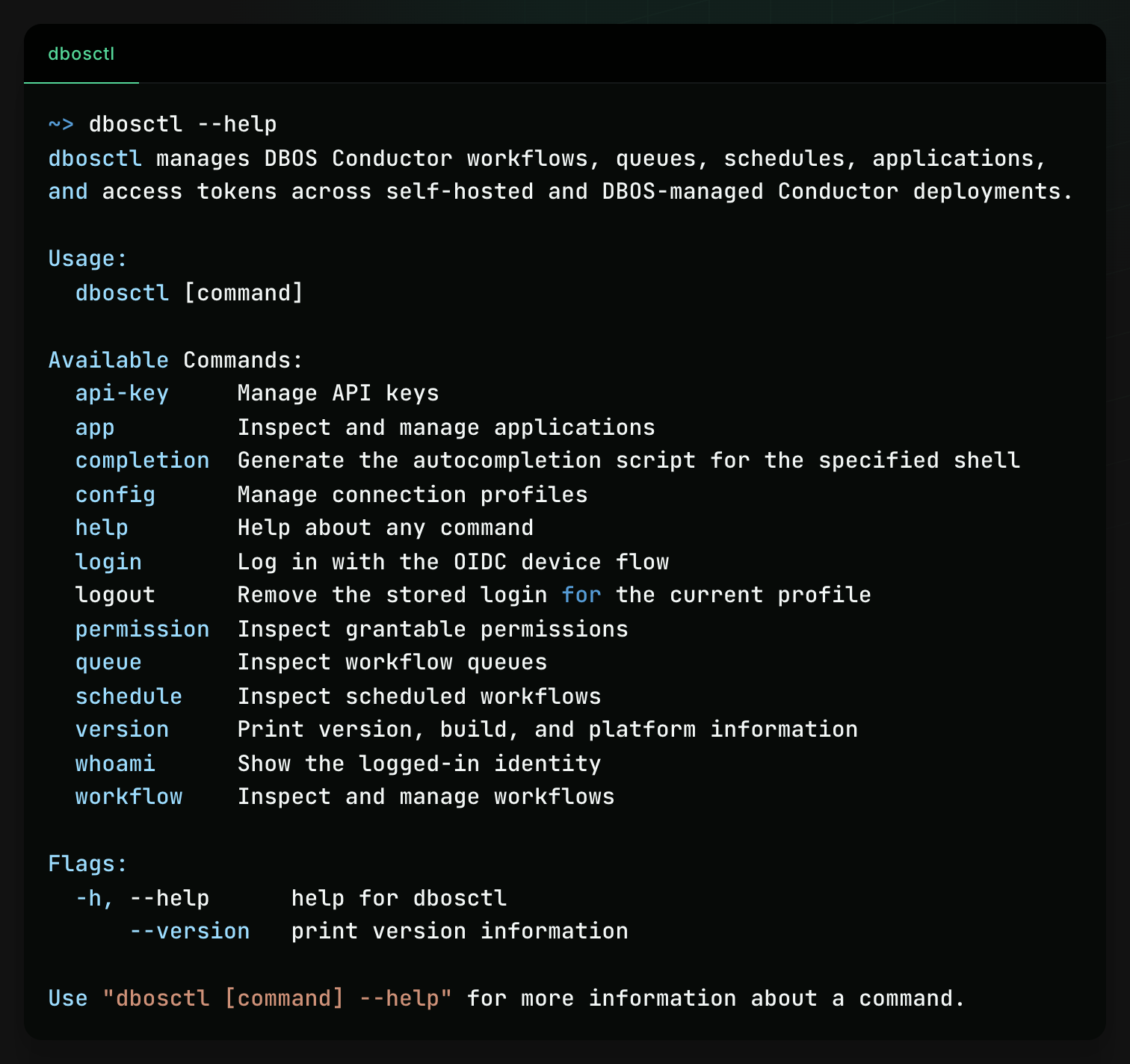
DBOS Conductor CLI command listing

dbosctl is useful for interactive operations, such as inspecting or recovering a workflow, as well as automated environments such as CI/CD pipelines. It provides a convenient, scriptable way to operate Conductor without building directly against the HTTP API.

Read the documentation to get started.

Metrics Preview Page

DBOS Conductor exports Prometheus/OpenMetrics-compatible metrics, so you can integrate workflow and executor telemetry with your existing observability stack. Metrics can be exported to any compatible backend, including Prometheus, Grafana, Datadog, the OpenTelemetry Collector, Honeycomb, and New Relic.

You can now also preview these metrics directly in Conductor UI from the new Metrics sidebar. This gives you an immediate view of workflow, step, and executor health and performance, making it easier to identify bottlenecks, investigate failures, and troubleshoot your applications without leaving Conductor.
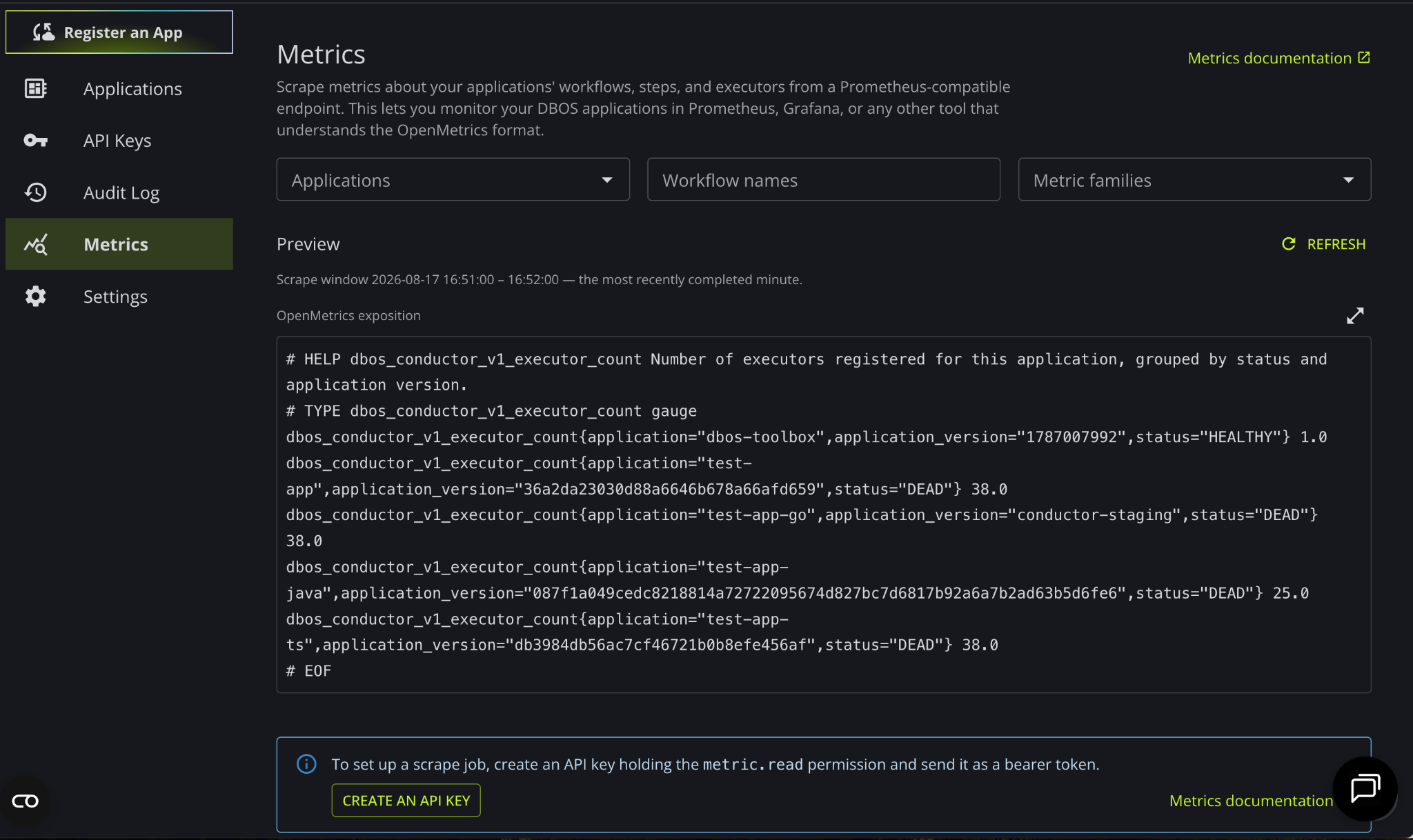
DBOS Condictor - OpenMetrics preview page

Learn More about Durable Workflow Orchestration

If you like making systems reliable, we'd love to hear from you. At DBOS, our goal is to make durable workflows as easy to work with as possible. Check it out:

Insights

Recent articles

The latest in durable execution, AI workflows & more.

DBOS Architecture
Aug 20, 2026

What is DBOS Conductor? 

Alex Poliakov, head of DBOS Solutions Architecture. explains DBOS Conductor.
DBOS
Benchmarks
Aug 10, 2026

Postgres SELECT DISTINCT Does Not Scale

Postgres SELECT DISTINCT performs surprisingly poorly. We explain why and how we mitigated it.
Peter Kraft
How To
Jul 24, 2026

Postgres LISTEN/NOTIFY Can Actually Scale

How we optimized Postgres LISTEN/NOTIFY-backed data streams at scale, achieving 60K writes per second with millisecond latency.
Peter Kraft

What's New in DBOS - August 2026

It's been another busy summer month at DBOS–big improvements in queueing performance, DBOS Go 1.0 is released, and a new CLI for DBOS Conductor! Here’s a summary of all things new:

New in DBOS Transact open source libraries

  • 10x better partitioned queue performance
  • More flexible database migration tooling
  • Better interoperability across applications and languages
  • DBOS Golang v1.0 release

New in DBOS Conductor

  • A public Conductor HTTP API specification
  • The new dbosctl command-line interface
  • Metrics preview page

Read on for the details.

New Features in DBOS Transact

10x Faster Partitioned Queue Performance

We significantly improved the performance of partitioned queues, delivering an order of magnitude higher throughput while maintaining low latency, even when queues contain large numbers of tasks. The optimizations include:

  • More efficient indexes, reducing the database resources required for each queue poll.
  • Batched dequeues, allowing a worker to dequeue tasks from multiple partitions in a single transaction.
  • A faster alternative to SELECT DISTINCT, which we discovered was a major bottleneck at scale. Read our technical deep dive to learn how we diagnosed and worked around the query-planning issue.

Partitioned queues are especially useful when your application runs tasks for many users or tenants. Unlike a regular task queue, a partitioned queue applies concurrency limits independently to each partition. This prevents a single tenant from consuming all available resources while still allowing tasks from many tenants to run concurrently.

In practice, we see people using partitioned queues to achieve fairer resource allocation, more predictable latency, and significantly higher throughput for multi-tenant workloads.

More Flexible Migration CLI Tooling

You can now print DBOS database migrations as a batch of raw SQL commands instead of executing them immediately. You can print either every migration for a fresh database or only the migrations after a specified version when upgrading an existing database.

The new options are:

  • --print-migrations <all|NUMBER>: Prints migration SQL to standard output instead of running it. Use all for a fresh PostgreSQL database or provide a migration number when upgrading an existing database.
  • --print-user-role: Prints the SQL statements that grant the application role access to DBOS system tables instead of executing them.

This gives you more control over how and when schema changes are applied. For example, a database administrator can review and execute migrations using a privileged role, while the application itself runs with a more restricted role. You can also incorporate the generated SQL into your existing deployment, review, and approval processes.

Available today in TypeScript, Python, and Go. Java support is coming soon.

Better Interoperability Across Applications and Languages

Multiple DBOS applications, including applications written in different programming languages, can now share a single DBOS system database.

Each application is identified by its configured name and owns the resources it creates, including workflows, steps, queues, schedules, and application versions. Applications are isolated from one another by default, but can interoperate explicitly by referring to each other by name.

For example, one application can enqueue a workflow owned by another application and wait for its result:

This is particularly useful for systems composed of multiple microservices or languages. Instead of operating a separate DBOS system database for every service, applications can coordinate through one shared database without interfering with one another.

This makes polyglot architectures simpler to deploy and operate while enabling durable, cross-application workflows. Read the documentation for usage details.

DBOS Golang v1.0 Release

DBOS Go 1.0 marks the DBOS Transact Golang as production-ready, with feature parity across the core DBOS programming model and a stable public API.

The new features include:

  • Database-backed queues and schedules. Queues and schedules can now be created at any time, including after application startup or through a DBOS client. They are visible to every process sharing the system database, replacing the previous in-memory interfaces. This makes them easier to manage in distributed and dynamically configured deployments.
  • A simpler client API. Client is now a sub-interface of Context, eliminating the duplicated Client* generics. One set of package-level functions now works both inside a DBOS application and from an external process, reducing API surface area and simplifying reusable code.
  • SQLite is now optional. Postgres-only applications no longer compile or link modernc.org/sqlite, reducing unnecessary dependencies and binary overhead.

DBOS Go 1.0 includes breaking changes. Read the upgrade guide for migration recommendations.

Going forward, we expect the public API to remain backward-compatible across minor releases, 

making upgrades more predictable and reducing ongoing maintenance.

New Features in DBOS Conductor

Public Conductor HTTP API Specification

DBOS Conductor now provides a public HTTP API specification, enabling you to integrate Conductor directly into your own tools and automation.

Through the API, you can:

  • Register applications and configure their settings
  • Search, inspect, cancel, and fork workflows
  • Inspect queues and schedules
  • Trigger and manage schedules
  • Read metrics and audit logs
  • Manage members, roles, and API keys

The API is described by an OpenAPI 3.1 specification generated directly from the running server, ensuring that the specification matches the deployed version of Conductor.

You can use the API with both DBOS-managed and self-hosted Conductor deployments. The specification also makes it easy to generate typed clients, build internal operational tools, or integrate Conductor with existing platforms.

Read the documentation for deployment and usage details.

The New dbosctl Command-Line Interface

We released dbosctl, a command-line client for the Conductor HTTP API. It lets you manage workflows, queues, schedules, applications, and API keys from your terminal.

It works with both DBOS-managed and self-hosted Conductor deployments.

DBOS Conductor CLI command listing

dbosctl is useful for interactive operations, such as inspecting or recovering a workflow, as well as automated environments such as CI/CD pipelines. It provides a convenient, scriptable way to operate Conductor without building directly against the HTTP API.

Read the documentation to get started.

Metrics Preview Page

DBOS Conductor exports Prometheus/OpenMetrics-compatible metrics, so you can integrate workflow and executor telemetry with your existing observability stack. Metrics can be exported to any compatible backend, including Prometheus, Grafana, Datadog, the OpenTelemetry Collector, Honeycomb, and New Relic.

You can now also preview these metrics directly in Conductor UI from the new Metrics sidebar. This gives you an immediate view of workflow, step, and executor health and performance, making it easier to identify bottlenecks, investigate failures, and troubleshoot your applications without leaving Conductor.

DBOS Condictor - OpenMetrics preview page

Learn More about Durable Workflow Orchestration

If you like making systems reliable, we'd love to hear from you. At DBOS, our goal is to make durable workflows as easy to work with as possible. Check it out: